
Why CFC Made the Decision Not to Commission Negative Suction ‘Storz’ Projects in Perth, WA

Introduction - Fire Hydrant Booster Systems with Negative Suction 'Storz' Design
Whilst this design can work in certain situations, we’ve found that the fundamental hydraulic principles are often overlooked during the design process by engineering consultants when specifying negative suction systems.
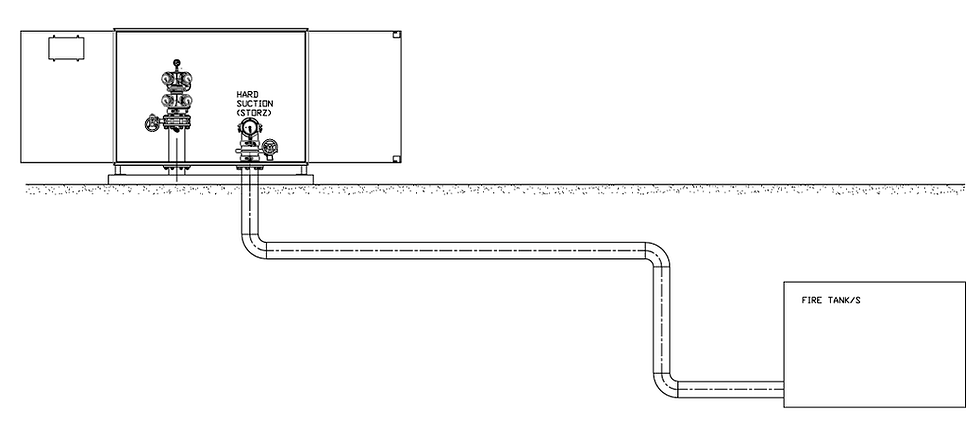
Common Design Errors
Locating the pump too high above the fluid source
Using an excessive suction pipe length
Installing too many fittings along the suction line
Selecting a suction pipe diameter that is too small
When these principles are ignored, cavitation is almost inevitable within the fire pump. Once present, this cavitation cannot be eliminated because the system’s inherent design is what causes it. This leads to reduced — or even completely lost — firefighting capability during a major fire event.
It doesn’t matter how large the fire pump is; if these basic hydraulic principles are neglected, complications on site are virtually guaranteed. A system might appear to function during commissioning, however we’ve been advised on several projects where continuous priming was required for extended periods — in some cases up to 30 minutes — before achieving stable flow. If a system requires multiple priming attempts or takes longer than five minutes to establish flow, we consider that a failure. Such systems should not be approved by a third-party contractor. These situations highlight how design limitations, rather than workmanship, can lead to ongoing operational challenges.
Why This Matters
During firefighting operations, time is critical. Firefighters must have an immediate, reliable water supply to their fire appliance. There should never be a need to continually prime a pump just to maintain consistent water flow.
What Challenges Does This Create for Contractors Commissioning Fire Hydrant Booster Systems?
When contractors are engaged to commission fire hydrant booster systems on commercial projects, several challenges arise.
The first and most significant is the potential damage to fire appliances. Negative suction systems place considerable strain on a pumping appliance. When a pump loses suction, it effectively loses its water supply — starving the pump of water. This can cause severe damage, particularly when continuous priming is required to maintain operation.
During testing, you can often hear the fire pump working much harder than usual. This happens because the pump is attempting to discharge a larger volume of water than what is being supplied to the impeller.
Another major challenge is communicating system issues to clients. When a system fails to perform, it’s common for contractors to be blamed — comments such as “you didn’t test it correctly” or “your pump appliance is too small” are frequently made. However, when the system’s hydraulic fundamentals are properly understood, it becomes clear that the real issue lies in the design, not the testing or equipment.
At CFC, we encourage fire system design consultants to attend the commissioning of fire hydrant booster systems, particularly where negative suction designs have been used. These systems are often commissioned without their attendance, and it’s crucial for designers to witness firsthand how such configurations operate under real boosting conditions. Doing so not only provides a clearer understanding of the challenges these designs create but may also lead to improved approaches for future negative suction projects.
Conclusion
Negative suction systems present significant and often underestimated challenges in real-world fire protection performance. At CFC, our decision not to commission these systems stems from firsthand experience and a commitment to ensuring reliable, immediate water supply to firefighting appliances under all operating conditions.

Comments